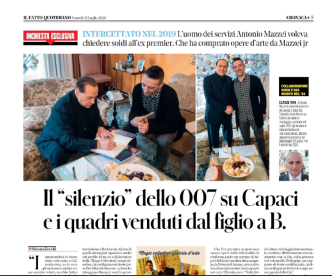
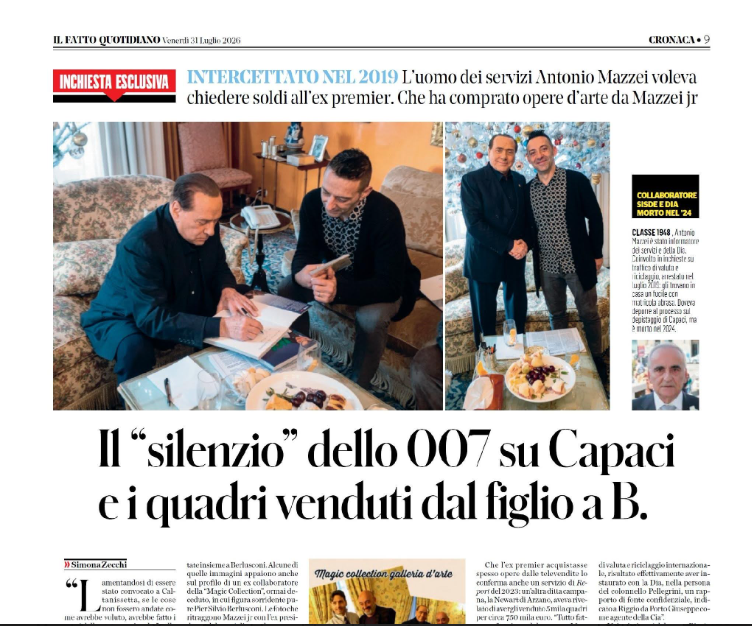
Last Friday July 31, our contributor Simona Zecchi signed an exclusive investigation on the Italian newspaper Il Fatto Quotidiano revealing that in 2019 — the same year a former Italian intelligence informant was wiretapped in prison threatening to approach Berlusconi to demand money for his silence — the former Italian prime minister was spending substantial sums buying artwork from a Naples-based streaming dealer called Magic Collection, owned by Francesco Mazzei, the informant’s son.
Investigators have confirmed over 500,000 euros in wire transfers between Berlusconi and the younger Mazzei, though no direct criminal link between the two stories has apparently emerged.
To understand the full weight of this story, some judicial context is essential. Italy is currently hosting – among others – an ongoing trial on the alleged cover-up of the 1992 Capaci massacre — the bombing that killed judge Giovanni Falcone, his wife and three escorts on May 23 1992 — in which two former carabinieri officers stand accused of obstructing investigators. It is in this trial that the wiretap of Antonio Mazzei sr. was recently presented in court by a former head of the Caltanissetta Mobile Squad.
Mazzei sr. was a former informant for two Italian intelligence agencies — SISDE and DIA — and his name appears in court documents related to both the Capaci cover-up investigation and the appeal ruling on the so-called “Trattativa” case, which spammed through 10 years (2013-2023): a long-running trial on alleged secret negotiations between the Italian state and the Cosa Nostra mafia in the early 1990s.
The story raises questions that go beyond Italy’s borders: about the opacity of Berlusconi’s art purchases in the final years of his life, about the networks gravitating around Italian intelligence in the post-massacre era, and about what a former secret service informant believed he knew — and believed was worth money.
The photographic evidence forms a striking part of the reporting. Francesco Mazzei’s social media profile carries images from 2019 showing him together with Berlusconi, and some of the same shots reappear on the profile of a now-deceased former collaborator of Magic Collection — a profile on which Pier Silvio Berlusconi, the former prime minister’s eldest son and heir to the family media empire, is also pictured smiling. Beyond the images with the elder Berlusconi, Francesco Mazzei is shown alone at the gate of Villa San Martino in Arcore — the Berlusconi family residence — in its garden, inside the study, posing in front of paintings, shaking hands, or apparently receiving a signed dedication in a book. Zecchi describes these photographs as suggesting a “jovial” rapport; Mazzei jr, interviewed by Il Fatto, characterises the same encounters as merely “correct and sincere” and insists they document only “two or three meetings.”
Pier Silvio Berlusconi’s response to the newspaper is emphatic. He says he does not know the people cited in the story and has never had any relationship with them. He recalls meeting them only once, in 2019, at Villa Gernetto — the estate where his father kept part of his art collection — after being invited by his father to see some works. According to his account, the encounter lasted only a few minutes in the presence of Francesco Mazzei and his collaborator, and he found the two men “excessively intrusive” from the outset. He tells Il Fatto he was annoyed at the promotional use of the photographs, which he insists “document a chance encounter” and imply no personal acquaintance. He also denies ever having taken any interest in his father’s art purchases.
Francesco Mazzei, for his part, confirms to Il Fatto that Berlusconi did buy from his company in 2019, but declines to specify either the amounts involved or the duration of the business relationship: that, he says, is “a question the Finance Police can ask me, not you.” He insists that his commercial dealings with the former prime minister “had nothing to do with” his father, and says he “would never have allowed” his father to insert himself into his professional world. Asked directly whether Antonio Mazzei had ever proposed business ideas involving Berlusconi, his answer was a flat “Never.” Pressed on the wiretaps themselves, he distances himself further: he says he knows nothing about the recordings, nor about his father’s “alleged secret life,” and adds that in his final period his father was “rambling.” He also says the family has drawn no benefit — financial or reputational — from whatever work his father may have done for the services.
Antonio Mazzei’s daughter Anna, who was present at the October 8, 2019 prison meeting alongside her mother and another sister, told the newspaper she does not remember her father speaking those words. She focuses instead on the sharp deterioration of his health after his time in prison. “For us it was a nightmare,” she is quoted as saying. “If these stories are true, he was sacrificed. He paid for someone else.” Pressed on who that someone else might be, she says she does not know: her father, she says, would tell the family nothing, and her attempts to press him got nowhere.
The core piece — the wiretap in which Antonio Mazzei is heard threatening to name names over Capaci and to demand money from Berlusconi to buy his silence — was read into evidence on May 5 this year by Marzia Giustolisi, former head of the Caltanissetta Mobile Squad, in the trial of the two former carabinieri officers, Angiolo Pellegrini and Alberto Tersigni, accused of obstructing the Capaci cover-up investigation.
Antonio Mazzei’s profile as an intelligence source is set out in a June 2, 1999 memo signed by Pellegrini himself, then a colonel, and filed in a case dossier labelled Z1500 concerning Pietro Riggio — the former prison guard turned mafia collaborator whose statements originally brought Mazzei’s name into the Capaci cover-up inquiry.
Mazzei is also described in the appeal ruling on the Trattativa case as a figure “gravitating in the underworld of the intelligence services,” with a criminal record for illegal weapons possession, currency trafficking and international money laundering, and confirmed as a confidential source for the DIA through Pellegrini. The same ruling records that Mazzei had been introduced to Riggio, via the former policeman Giuseppe Leonardo Porto, as “a CIA agent.” According to Riggio’s account, in the early 2000s he was approached — via Porto and Mazzei, both in contact with Pellegrini — to join a “task force” to hunt down the then mafia boss Bernardo Provenzano (later revealing itself to hide other obscure motives instead) , and later heard from others in that group that the Capaci massacre had involved “persons external to the mafia.”
The scale of Berlusconi’s dealings with televised art dealers is not, in itself, unprecedented: a 2023 report by the RAI investigative program Report revealed that another Campania-based firm, Newart of Arzano, had sold him roughly 5,000 paintings for around 750,000 euros. Prosecutors in Caltanissetta already had both the elder Mazzei’s wiretap and the commercial dealings between his son and Berlusconi on file — but, as things stand, no direct link has been established between Antonio Mazzei and Berlusconi, and no criminal exposure attaches to any of the individuals named. Antonio Mazzei died on November 3, 2024, roughly a year and a half after Berlusconi — the man he had told his wife and daughter, in that prison room, he intended to approach for money.
Curiously enough, in the very days the investigation appeared, a separate piece of news surfaced too, almost accompany it. On July 31 — the same day Zecchi’s report was published — many news outlets reported that the hangar at Arcore which for years housed Silvio Berlusconi’s vast art collection is set to be demolished and replaced by a branch of Eurospin, an Italian discount supermarket chain. The structure, according to the paper, contained roughly 25,000 works— the bulk of them acquired precisely through the nighttime television art sales that are at the heart of the Mazzei story. Lucas Vianini, the longtime curator who arranged the collection and spoke to Corriere della Sera, said with some bitterness that he is “sure it would not have pleased” the former prime minister. Vianini describes a collection organised into thematic paths — still lifes, religious subjects, mythological scenes, historical portraits, reproductions of great masterpieces — and a plan, never realised, to eventually open the hangar to the public with an educational function. Among the pieces stored there, according to his account, was a giant portrait of Berlusconi himself on canvas.
The coincidence of timing is striking: as the judicial and journalistic sections question who sold those thousands of paintings, and why, the physical space that held them is being cleared to make way for a discount grocery store.
Blindspot Team