The early hours of March 1st—echoing with the resonance of explosions and news of a military strike by the United States and Israel against Iran—did more than shift the region’s geopolitics; they shifted the ethical and moral boundaries of a segment of the Iranian diaspora. The jubilation and celebration displayed by the warmongering faction of the diaspora in response to this carnage and destruction are more than mere emotional catharsis. They signal a profound crisis in the “understanding of freedom,” “moral responsibility,” and “individual accountability.” This essay endeavors to analyze this phenomenon.
At the outset, it must be stated that this critique does not ignore the domestic realities of state repression or political stagnation within Iran. However, these reflections focus specifically on the political behavior of a particular diaspora faction and do not characterize the Iranian community abroad in its entirety.
I wish to clarify at the outset that this critique does not ignore the domestic realities of state repression or political stagnation within Iran. Furthermore, it must be noted that these reflections pertain to a specific segment of the Iranian diaspora and do not characterize the community in its entirety.
1. Where in the world do we stand? The bloody geography of double standards
Contrary to the evolutionary claims of modernity, the opening decades of the 21st century have been transformed into a slaughterhouse for human ideals. We live in an era characterized by the “summation of atrocities.” From the rise of extremist groups like ISIS and the Taliban—products of direct or indirect interventions by the United States and its regional sub-hegemons—to the overt genocide perpetrated by Israel in Gaza, supported by the full military and political weight of the West (particularly the U.S., Germany, and the UK), a stain has been left upon the brow of contemporary civilization.
In this landscape, the Russian invasion of Ukraine, framed against NATO’s expansionist agenda, has laid bare a profound set of “double standards.” While the West invokes “national sovereignty” for Ukraine and provides unreserved military support, it simultaneously paves the way for Israel to swallow the remaining Palestinian territories. The catastrophe in Gaza alone is sufficient to expose the fraudulent credibility of Western “human rights”—a mask behind which hides the barbarism of Western leaders and the calculated inaction of regional states.
This double standard has repeated itself in recent days. It is unsurprising that the West, as a partner in this conflict, subverts the truth by labeling Iran’s legitimate defense as a “threat” while characterizing the military aggression of the U.S. and Israel as a “liberating” act. The same powers that have spent decades offloading the cost of Germany’s historical antisemitism onto the Middle East have now turned Iran into a laboratory for modern barbarism and unrestrained militarism. To the West, historical truth, ethics, and international law are merely instruments of hegemony, manufactured or sacrificed according to interest—as witnessed in the occupation of Palestine and the genocide in Gaza. Today, within the geography of Iran, the lives of citizens and children are treated as mere “collateral damage” in geopolitical equations; a truth consciously lost in the din of bombs so that the project of destroying a nation and plundering its wealth can be legitimized under the deceptive banners of “democracy” and “liberating a people from a dictator.”
In such a toxic atmosphere, news of the assassination of Ali Khamenei brought exhilaration to a segment of the diaspora. While moving past dictatorship is a legitimate aspiration, the euphoria surrounding this event is tinged with a sense of humiliation and portends a tragedy: a celebration of the end of a sovereignty, achieved not by the hands of the people, but by the world’s most predatory powers. Scenes of dancing with American and Israeli flags and offering flowers to embassies whose bombs were destroying Iranian schools, hospitals, and national infrastructure represent a total moral and human collapse.
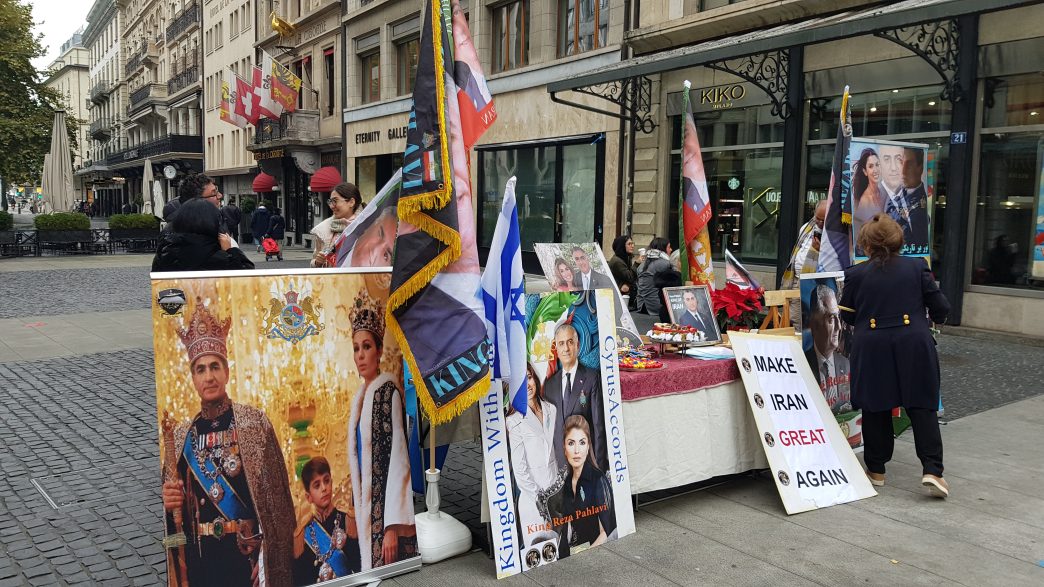
By considering Trump and Netanyahu as “humanitarians” and “peacemakers,” the warmongering diaspora has effectively become the path-paver for the destruction of their own birthplace. They have even recruited from the so-called “intellectual” class and Nobel Peace Prize winners—elites who, by appearing on outlets like Iran International and Manoto, or mainstream Western media, have become academic apologists for military aggression. At the helm of this movement stands Reza Pahlavi, who, by honoring foreign soldiers and petitioning Trump for military intervention, sacrifices the children of the homeland at the feet of “three heroic American soldiers.”
The bitter truth is this: while the German Chancellor explicitly states that Iran is not “covered by the protections of international law,” and while Trump and Netanyahu openly declare their intent to destroy Iran, warmongering Iranians abroad—clinging to the illusion of “liberation through the barrel of a gun”—dance and celebrate the collapse of their ancestral home and the mangled bodies of children, expressing gratitude to the world’s foremost warmongers.
2. Analyzing the condition: the paradox of freedom
Those who view war as the path to liberation appear ensnared in a “paradox of freedom”—a state where liberation from internal tyranny is sought at the cost of the homeland’s annihilation and the liquidation of its people. We shall now examine the dimensions of this phenomenon.
The logic of the “state of exception” and the devaluation of human life
In this worldview, war is not a catastrophe but a “necessity” for the “transition period” toward “freedom.” Borrowing the concept of the “State of Exception,” the life of the person inside the country—from a child in Minab to an ordinary citizen—is reduced to a mere digit in a strategic calculation.
Consequently, the lives of those within the country, such as schoolchildren, hospital patients, or ordinary pedestrians, are deemed to have no value relative to “freedom.” More precisely, they are viewed as worthy sacrifices for a “greater” goal, a killing that is not categorized as a crime. This “freedom,” however, is nothing more than power and wealth, and that “noble” goal is simply the domination of one group over the collective. This logic extends to the common citizen: the fate of the state and anyone connected to it—whether by choice or necessity—is predetermined as expendable, turning their slaughter into a source of jubilation.
The aesthetics of destruction and the “false sublime”
Watching massive explosions from the safety of screens in the West has transformed war into a “dazzling spectacle” and a “false sublime” for a segment of the diaspora. The horrific magnitude of destruction and the presence of corpses, rather than evoking compassion, elicit admiration.
In this visual perversion, the fire of missiles does not signal horror or the incineration of human flesh; it is interpreted as the “light of freedom.” The celebratory carnivals in Western streets—complete with rhythmic music and the waving of Israeli and American flags—function as a form of “aesthetic censorship.” It crops out the stench of gunpowder, blood, and the cries of mothers to package the demonic reality of war as a stylish “pro-democracy” product. This group harbors a fetish for “creative destruction” rather than civil evolution, believing that for a prosperous Iran, everything built by the current political system must be razed. They ignore the reality that in the material world, the ruins of war are not a bed for democracy, but a swamp for civil war and neo-fascism. This gaze sacrifices the visceral, bloody truth of the field at the altar of a base and dehumanized political fantasy.
The trap of “liberatory colonialism”
The manic euphoria surrounding military strikes likely stems from being trapped in the worn-out, self-justifying logic that “the end justifies the means.” Within this abstract reasoning, eyes are willfully shut to the bloody contemporary experiences of Iraq, Syria, Afghanistan, and Libya—models proving that “freedom” emerging from the barrel of a foreign soldier’s gun leads to structural ruin, resource pillaging, and “modern slavery.” By evading a fundamental moral and political question, this movement has effectively turned toward theorizing a form of “liberatory colonialism.” Yet, whatever is built upon the ruins of the paternal home and the corpses of innocent humans may be many things, but it is certainly not freedom.
The truth is that when the “means” are devastating bombs and missiles, the “end” can never be democracy. In this logic, freedom is no longer an inalienable right of the Iranian people; it has been transformed into a “political commodity” in geopolitical transactions. Authentic liberation is a process that arises from the heart of social struggles and the organic bond of the masses, not from the smoke of Israeli, U.S., or NATO explosions whose sole objective is a “scorched earth” to secure their own hegemonic stability.
The decay of the national idea and unproductive resentment
Furthermore, celebrating the destruction of national assets and historical landmarks signals the collapse of the “national imagination.” One who cheers the bombing of their own country can no longer share in the “suffering of the Other.” They view Iran not as a living human body, but as an “occupied map” where purging is permitted at any cost.
In this strike, historical buildings such as the Senate (Assembly of Experts) and the Golestan Palace Museum were targeted. To the war-infatuated subject, this is acceptable: they believe they will simply build better ones in a “free” Iran. This subject is so immersed in euphoria that they remain indifferent as historical memory and collective consciousness are plundered, and the very fabric of national identity unravels.
3. The sacrifice of truth: propaganda and the death of the real
In modern warfare, “truth” is assassinated before the first bullet is fired. What we are witnessing today regarding the military aggression of Israel and the United States against Iran is the reduction of truth to “media representation”—a process in which the raw reality of the field is replaced by constructs manufactured in the studios of London and Washington. The exhilaration of a segment of the diaspora is a direct product of this “industry of deception.” A chain of Persian-language media outlets—led by Manoto and Iran International—fueled by the massive budgets of interventionist powers (particularly the U.S., Saudi Arabia, and Israel), beautify horrific violence with graphic, high-definition imagery of “pinpoint” missiles and clinical terminology like “precise surgery” or “excising a cancerous tumor.” In this linguistic inversion, the “destruction of national infrastructure” is renamed “liberation,” and the “slaughter of civilians” becomes “collateral damage.” By boycotting the narrative of the victim, the children killed in schools and hospitals are lost in the clamor of virtual carnivals.
Furthermore, the roots of this intoxication lie in a dependency on narratives dictated by global centers of power. Years of “absolute demonization” and the justification of paralyzing sanctions by foreign-funded media have produced a generation of activists who, instead of relying on the power of the people, seek “liberation” at the hands of interventionist powers. This segment of the diaspora, by recirculating colonial subtexts, has effectively become the operational arm of a “reality-making” project for warmongering powers.
The celebration of foreign soldiers while ignoring decades of economic warfare that has crushed the Iranian people indicates a profound cultural and political alienation. By reducing Iranian identity to a few “window-dressing” symbols and ignoring the reality of New Colonialism, this movement has become the path-paver for projects whose goal is not “democracy for Iran,” but the collapse of Iranian independence and its total submission to Western hegemony.
Years of exile and immersion in a world saturated by media that reduces the complexities of Iranian society to “good vs. evil” clichés have created a form of “moral blindness” toward both suffering and internal progress. This gaze reduces the entirety of the last 47 years to “absolute evil,” blacklisting any positive or independent action that occurred outside the ruling ideology to serve the dominant narrative.
This historical alienation prevents an understanding of the fact that the West and Zionism have spent over three decades systematically isolating Iran to dismantle the nation’s fabric. Those cheering for military intervention ignore the explicit aim of sanctions—admitted by their architects in Washington—which was never democracy, but the destabilization of the people’s livelihood and territorial ruin. In this intellectual framework, the “dictator” is reduced to the sole cause of misery to absolve international plunderers of their historical responsibility for the collapse of Iranian human life.
Ignoring Iran’s unique position on the Middle Eastern map is the strategic blunder of those supporting the military option. For decades, Iran and its people have paid the exorbitant costs of isolation to avoid becoming a pawn in the “Great Power” games. Unlike other countries in the region that host foreign military bases, Iran chose the difficult path of standing against a Western-imposed order—a path that, while costly, prevented the direct presence of foreign boots on the ground.
This “structural non-alignment” and the refusal to integrate into the neoliberal and military order of the West is the “unpardonable sin” for which the penalty is soul-crushing sanctions and now the bombing of infrastructure. The diaspora cheering for the bombs is actually witnessing the West’s revenge against a nation’s “will for independence.” They are unable or unwilling to see that the ultimate goal is to break the only existing barrier to absolute U.S.-Israeli hegemony in the region and transform Iran into an obedient “failed state”—a process deceitfully labeled as “returning to the international community.”
This process is indifferent to the specific system of governance in Iran. Any political structure—religious or secular, democratic or autocratic—that obstructs the Western hegemonic process will meet the same fate in the contemporary world. This is the key to understanding the international political crisis of our time.
4. Identity pathology: From “alienation from the subject” to the “fetishism of destruction”
What is observed in the behavior of the warmongering diaspora appears to be more than a political stance; it is an identity pathology—a product of the process of alienation. To understand this collapse, one must deconstruct the human and social layers of this phenomenon.
A segment of the diaspora, due to physical distance and years of living within the atmosphere of the “Global North,” has severed its link with the pulsating reality inside Iran. In their minds, Iran is no longer a collection of real people, situations, and the lived anxieties of daily struggle; it has been reduced to an abstract idea. Reality, for them, is confined to what they hear through social media, Western outlets, and occasional anecdotes from relatives. When the bond with the objective reality is broken, an individual can easily remain indifferent—or even cheer—for the destruction of structures in which they themselves do not live. This disposition can be viewed as an indifference toward individual and moral responsibility, a trait nourished by “geographical immunity.”
Such a condition allows the warmongering diaspora to engage in the “dehumanization” of their homeland and its people, constructing them as an “Other.” To comfortably support a military strike, their first step is to regard their compatriots inside the country as “alien.” In this view, the people inside are either “complicit with the system” or a “passive mass” whose biological value is less than the abstract ideals of this diaspora faction. Here, the colonial logic is reproduced: “Kill the natives to save them!” They issue calls for war from across borders, but the cost is paid not by residents of California, London, or Paris, but by Iran’s subaltern classes—with their hungry lives and their blood. The truth is that this movement speaks with the “language of the victim” but prescribes solutions with the “logic of the executioner.”
Amidst this, the manufactured and glamorous representation of the Pahlavi era in media outlets like Manoto has channeled this identity crisis. The fetishism of returning to a past “glory and grandeur” is sought not through civil struggle, but—as Reza Pahlavi has entreated from Trump—through the barrels of Israeli and American guns. The ultimate irony is that many of these “war-prescribers,” even if a new order were established upon the ruins of war, would be unwilling to return and live under those conditions. In this worldview, the homeland is not a “shared home,” but an “exportable political project” that must be constructed by a foreigner.
5. The catastrophic consequences of sacrificing truth: From human desensitization to national rupture
The sacrifice of truth carries horrific human consequences. When the reality of the “Suffering of the Other” is obscured by selective representation and the manipulation of facts, it paves the way for a systemic desensitization. At this juncture, empathy begins to decay. In such a state, the death of a human being—in this case, a compatriot—ceases to evoke a response; instead, it is rationalized as a “necessary cost of transition.” This is the threshold of modern barbarism.
Furthermore, the truth being slaughtered today amidst the street celebrations and the jubilation of the warmongering diaspora sows seeds of resentment and suspicion for future generations. When a segment of the diaspora, whether consciously or unconsciously, cheers for military intervention—resulting in the destruction of the homes of their fellow citizens and their subsequent slaughter—the “truth of national unity” is decimated for decades to come. Collapsed buildings might eventually be rebuilt with the dollars of colonizers—at the price of economic and political bondage—but historical humiliation and the deep lacerations to a nation’s collective conscience can never be easily healed.
Ultimately, the sacrifice of truth allows those who profit from war (be it politically or emotionally) to evade their individual and historical responsibility. Sheltering in the shadows of media-manufactured lies, they escape the formidable question: “What is our moral responsibility toward the future of this land?” The bitter reality is that silence, or the encouragement of military intervention, is not “activism for freedom.” It is complicity in a project to destroy the future of Iran’s children—a betrayal that future generations will not forget.
6. Final word: reclaiming truth and collective conscience as the only path to liberation
Without reclaiming the truth, no sustainable freedom will ever be born. A “liberty” built upon the foundations of deceit, propaganda, and the denial of innocent blood will inevitably mutate into a new tyranny. Standing on the right side of history means standing with the “naked truth of Iranian human suffering”—a truth that pulses not in the studios of London and Washington, nor in the digital algorithms of Elon Musk and Mark Zuckerberg, but in the heart of Iranian streets and in the terrified eyes of a people who refuse to be cannon fodder for global power equations.
The path to Iran’s liberation does not pass through the vice of “domestic autocracy” and “foreign warmongering.” The fate of Iran cannot be surrendered to the “smart bombs” and diplomatic smiles of the Global North’s warmongers, who have repeatedly demonstrated that democracy and human rights in the Global South hold no intrinsic value for them. Iran’s salvation will be forged only when the hands of Iranians—of all persuasions and backgrounds—are clasped together once more. Though the hour is late, we require, now more than ever, an honest dialogue between diverse Iranian groups, both internal and external. The diaspora must emerge from the cocoon of its delusions and hear the authentic voice of the Iranian street—a voice that seeks neither bombs nor the West’s cruel sanctions, but thirsts for dignity, security, and endogenous change.
The moral and national duty of the intellectual and the activist in exile is not to “cheer for the bombs,” but to safeguard the “right to life” and the “right to self-determination.” We require a resistance and a struggle that simultaneously stands against domestic tyranny while refusing to allow the “homeland” to be turned into a weapons laboratory for global powers or a target for unjust, inhumane international sanctions. A freedom that carries the scent of foreign gunpowder is a fetus aborted before birth. The authentic Iranian identity in exile finds meaning not in complicity with projects of collapse, but in convergence and solidarity with the real suffering of compatriots and the preservation of the material and spiritual integrity of an independent Iran—one where human life is not sacrificed for geopolitical games.
Ultimately, this is not a choice between the “bad and the worse.” It is a warning regarding a historical truth: the first victims of the war machine are always civil society, protest movements, and their hard-won achievements. War poisons the breathing room of independent social movements; by enforcing absolute securitization, it drains the last vital energies of society for any democratic, internal transformation. To stand against the bombs is, in truth, to defend the possibility of the Iranian people’s ongoing civil struggle. Amidst the rubble of war, only fascism and new forms of plunder sprout—never liberty.
Bio:
Ali Jafari is a lecturer, researcher, and journalist who holds a PhD in Sociology from Sorbonne University and has conducted post-doctoral research at the University of Tehran. He has lectured at institutions including Lumière University Lyon 2, École Normale Supérieure (ENS), and Jean Monnet University, specializing in the sociology of education, gender studies, and visual anthropology.
His professional background includes more than 15 years as a journalist, complemented by documentary filmmaking training at École de l’Image Gobelins. An expert in French and a native speaker of Persian and Turkish, Jafari has authored numerous publications on ideological domination, social movements, and the politics of aesthetics in the Iranian education system.