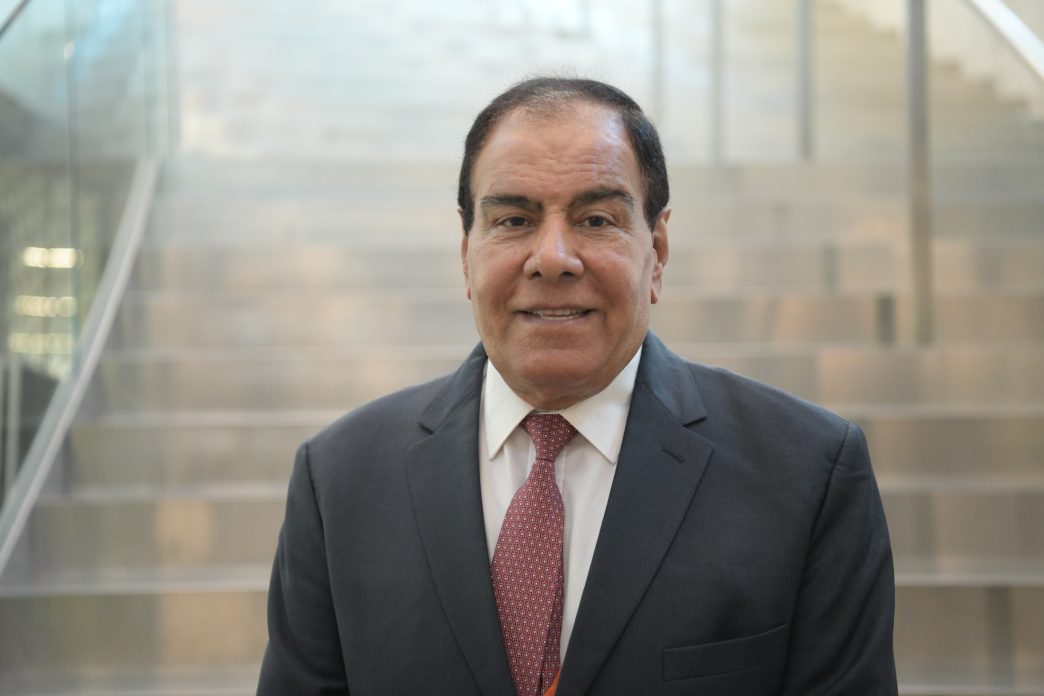
“The question of Israel’s right to exist must be posed in another way. Israel cannot exist as an ethnic and colonial state,” says Dr. Izzeldin Abuelaish, known as the first Palestinian doctor to hold a staff position at an Israeli hospital, in the 1990s.
“Israel cannot exist as a system of nationalism, only if based on international law,” the obstetrician reiterates.
Abuelaish points the finger at an unviable supremacist model, established with the goal of expansion and colonialism. “Israel is the only country with undefined borders, in order to expand. It has no constitution. So, their existence, where and how? And what about the neighbors, the Palestinians’ existence?”
In January 2009, Israeli shells fell on Abuelaish’s family home in Gaza, killing three of his young daughters – Mayar, Aya, and Bessan – and their cousin, Noor. He then called his friend at the Israeli Channel 10, reporter Shlomi Eldar, who put grief-stricken Abuelaish on speaker phone, live on TV.
The tragic loss of his daughters and niece was not the last. On November 7, 2023, an Israeli airstrike hit the home where his relatives were sheltering in the Jabalia refugee camp, killing 22 members of his extended family.
Despite all the suffering, Dr. Izzeldin Abuelaish insists on appealing for equality between Palestinians and Israelis. “I will continue to advocate for our rights, for our justice, for the life of the Palestinians, for the freedom of the Palestinians, for the equality between Palestinians and Israelis.”
But for this to be possible, “it’s time to stop Israel’s expansive colonization and ideology,” he emphasizes. “See what is happening in the West Bank, the suffocation of the Palestinians. And expansion of the settlements in Lebanon, in Syria, in other parts.”
All of this steams from an ideology “that considers Israel the state of a chosen people with the right to expand what they call Greater Israel,” says Abuelaish, adding that this project only persists thanks to the immunity provided to Israel by the American administration and some Western countries. “They have been violating the international law, and we need accountability for what they acted. It’s time to resume trust in the international community, and to endorse international human rights.”
Accused at times of promoting the normalization of an Israeli system of violence, Izzeldin Abuelaish categorically denies this. “I never said I promote coexistence and normalization. What I always wanted was for the Israelis to see us Palestinians as human beings and to abandon hatred. I want them to see the pain of the Palestinians as equal to the Israelis. Hatred is a disease.”
After the killing of his three daughters and niece by the Israeli army, the obstetrician moved to Toronto, and filed a lawsuit against the state of Israel, demanding an official apology and compensation for the killing of his three daughters and niece. On November 2021, Israel’s Supreme Court rejected Abuelaish’s appeal, which had already been denied him by a lower court.
Betrayed and ignored, he did not give up the fight, committed to make the world see the human face of the Palestinians and their suffering, in a world which is endemic with disinformation, and biased media that describe the Palestinians as monsters.
“We are people like others. We are people who are seeking their freedom and their justice. And it’s the responsibility of the Israelis to take action to put an end to the suffering of the Palestinians by ending the occupation and to free Palestine,”concludes the doctor from Gaza.
Nelson Pereira
BIO - Dr Izzeldin Abuelaish

Dr Izzeldin Abuelaish wrote a memoir of his experience: "I Shall Not Hate: A Gaza Doctor’s Journey on the road to Peace and Human Dignity," published in 2001.

The Canadian-French documentary film "I Shall Not Hate," directed by Tal Barda and released in 2024, was adapted from Abuelaish's book.

The five-time Nobel Peace Prize nominee is now a professor at the Dalla Lana School of Public Health at the University of Toronto.