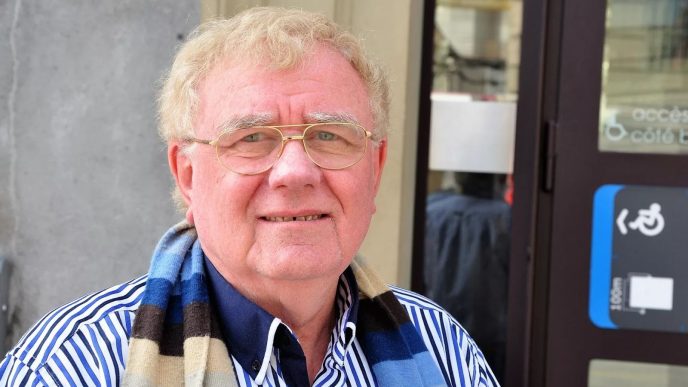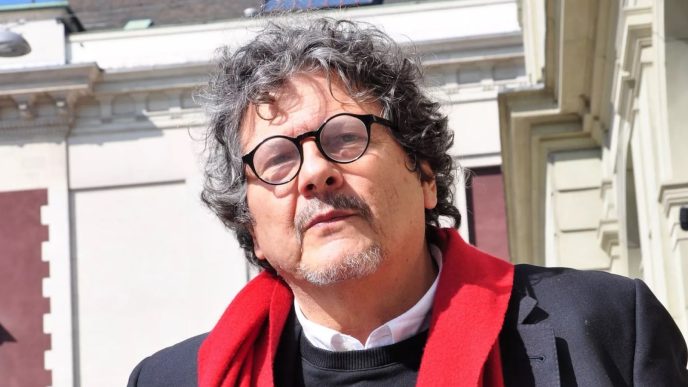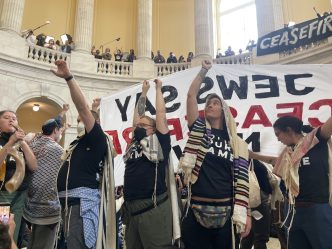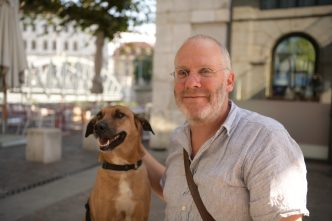
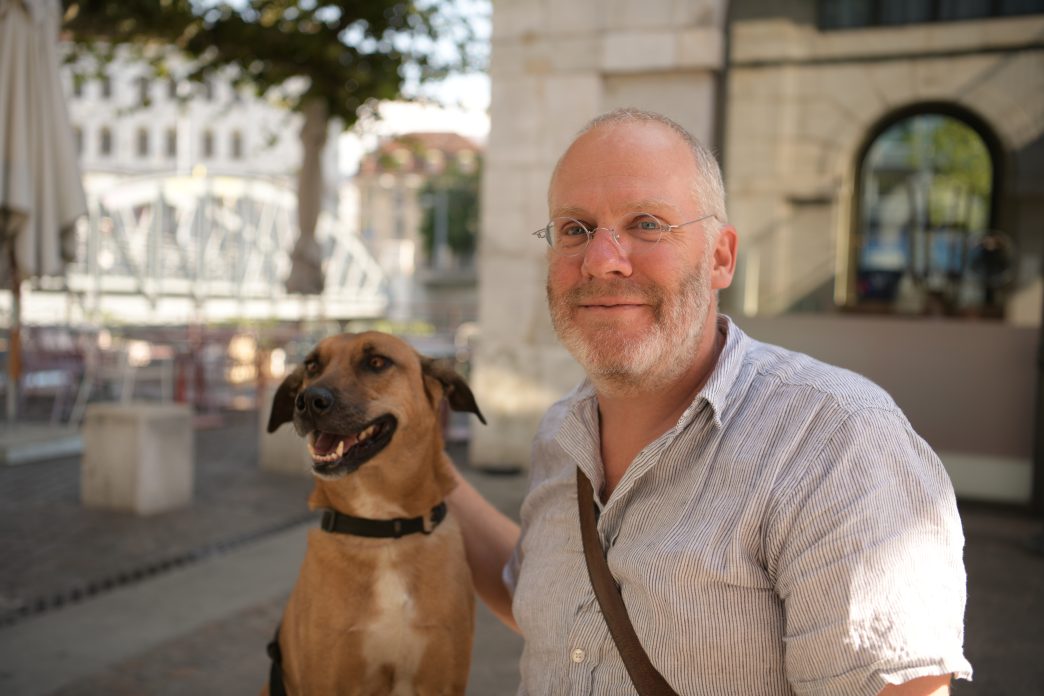
Swiss national Samuel Crettenand became involved very early on to draw the attention of the media, politicians and the public to the massacre of children in Gaza. In December 2023, he began a hunger strike, marching with a sign that he updated daily with the number of victims. He then became involved in organizing the World March to Gaza and the Global Sumud Flotilla. At home, he doesn’t miss any opportunity to confront government officials about Switzerland’s complicity in the genocide perpetrated by Israel.
An archaeologist by training, Samuel Crettenand made several trips to Syria as part of archaeological research expeditions on the heritage of early Christianity, before dedicating himself to publishing works on cultural heritage, archaeology and ethnography. Invited by the Geneva Museum of Art and History to join a mission in Gaza in 2005 to collect photographs for the publication of an exhibition catalogue, he returned to the Gaza Strip in 2008 to complete the exhibition inventory. The first visit took place when the last settlers were leaving the Gaza Strip as part of the Israeli withdrawal initiated by Prime Minister Ariel Sharon. The second event occurred after Hamas came to power, when the population of Gaza was under total blockade.
Upon learning of Hamas’s incursion into Israel on October 7, 2023, Crettenand’s first thoughts were for the population, certain that Israel’s response would be, as always, terrible and that civilians would pay a high price. “Three days later I realized that Israel was carrying out a plan of ethnic cleansing. I realized it was genocide, a kind of final solution.”
After a few weeks, he received the first news from friends who had taken refuge in Rafah, in the far south of the Gaza Strip. “I asked them what they ate. And I decided to eat the same thing every day, out of solidarity. Then I thought it was good for my conscience, but that to help my friends I had to do more, I had to publicize what was happening to them. So, I decided to start a hunger strike.”
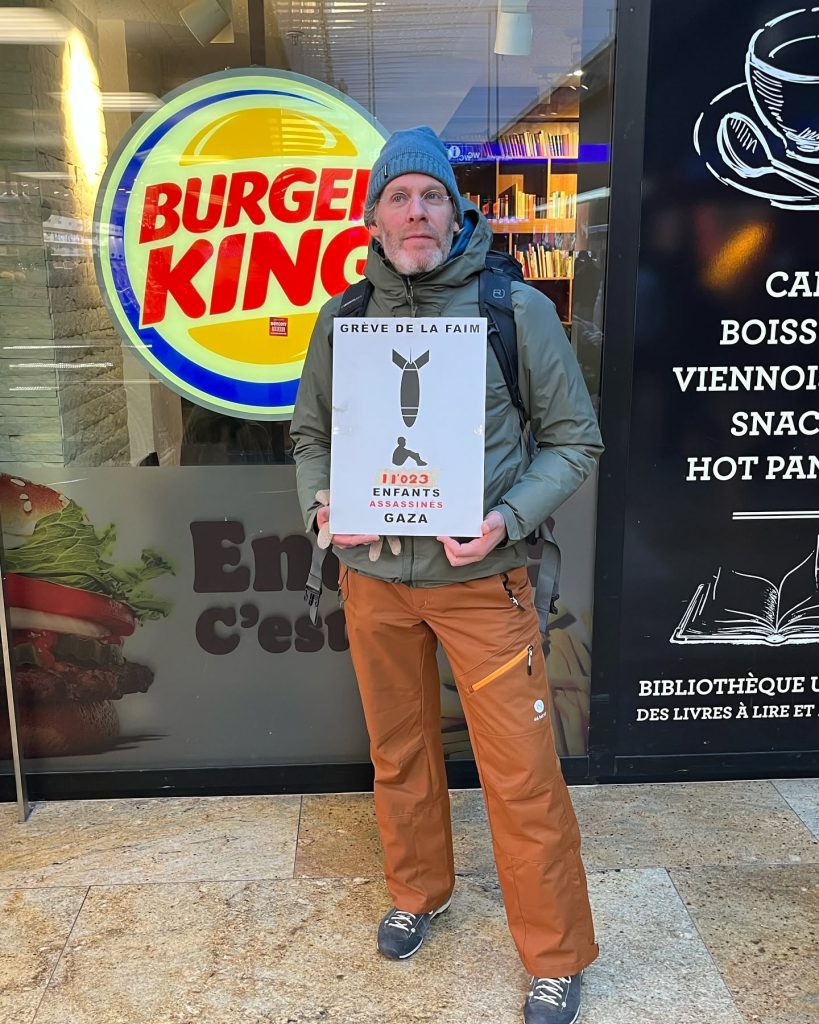
On December 12th, he began a hunger strike that would last 40 days.
© Samuel Crettenand
And he decided to go to the streets, holding a sign that read the number of children murdered in Gaza by the Israeli military operation, a number he kept updating. “I went out to Federal Square almost every day during the winter sessions, attended conferences and demonstrations, and went to train stations.”
Fascist Tendencies
The hunger strike of the pacifist activist for the children of Gaza is unsettling the state apparatus. He is followed by police officers and frequently subjected to identification checks, particularly when protesting in the Swiss capital. The fact that he acts alone increases the frustration.
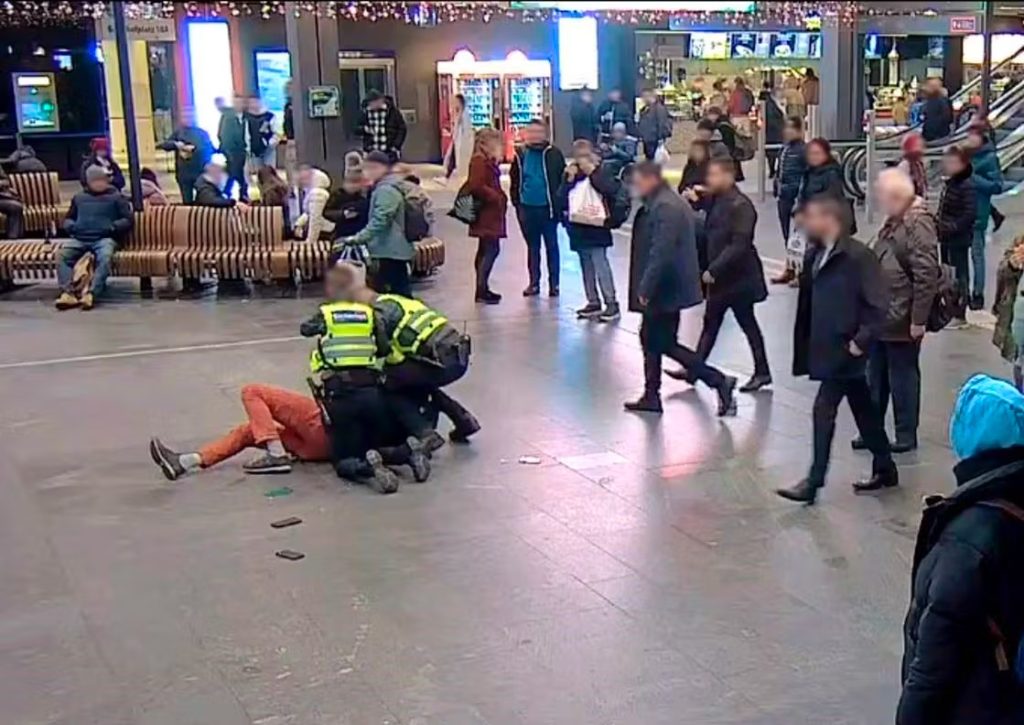
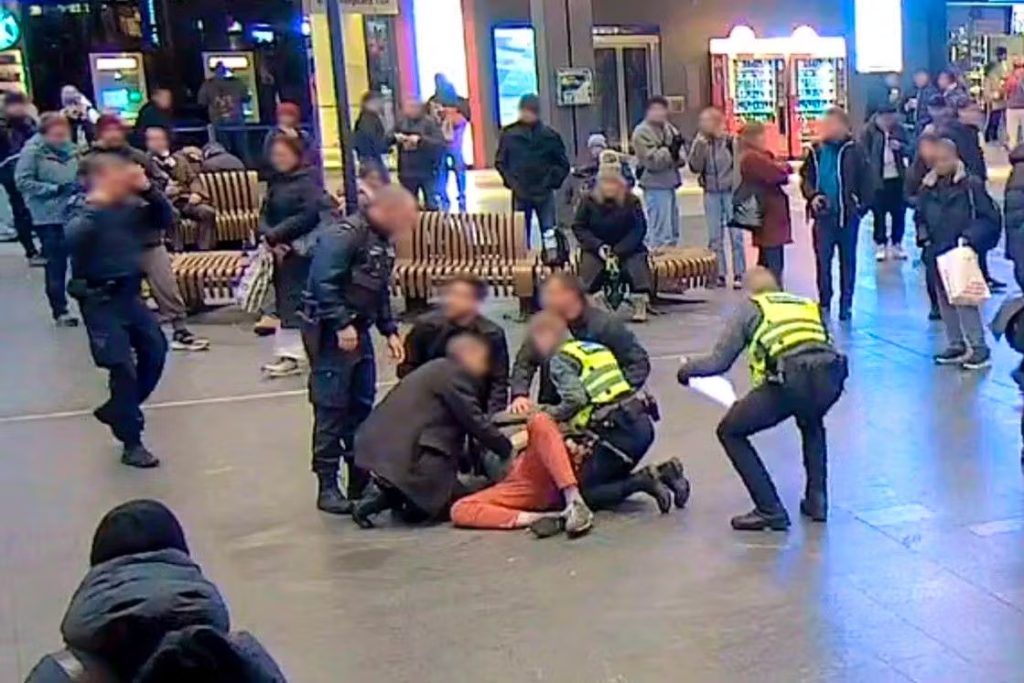
Crettenand had been on hunger strike for a week when, on December 18th, at the Bern train station, he was brutally attacked by private security guards from the Swiss railway company, police officers, and unidentified individuals suspected of being agents of the Swiss Federal Police (Fedpol). “I was first approached by two private security guards who asked for my identity document, which I presented. They told me I was banned from the station for 48 hours, which I refused. I politely asked them to give me back my ID so I could continue my protest. When they refused, I took the ID, which one of the officers had placed on a tray. They lunged at me and tried to force me to the ground.”
That’s when three men dressed in black appeared. They restrained and handcuffed Crettenand, then handed him over to two Bern police officers and disappeared without a word. Despite the pacifist activist’s explanations, who claimed to have been on a hunger strike for seven days, they took him to a cell where he lost consciousness. “When I woke up, half-conscious, a police officer was hitting me in the chest and thighs, while shouting, ‘You’ll continue to suffer if you don’t stop your charade.'”
Suffering from respiratory distress, he called for medical assistance. The mistreatment only ceased when the paramedics arrived. He was hospitalized and received a medical report documenting the blows he sustained.
Samuel Crettenand filed a complaint against the police officers and immediately requested the preservation of the station’s security camera footage. This followed initial statements by the police and the Swiss Federal Railways that the footage of the incident had been deleted from the system. However, the Bern public prosecutor’s office subsequently indicated, based on a selection of video footage in its possession, that Crettenand was responsible for violence against the police due to his resistance and refusal to comply. The activist’s lawyer appealed, and thus the station’s security camera footage was finally added to the case file a year later. The footage shows the three plainclothes officers. Although they wore no distinctive insignia, it was clear they were known to the station’s private security service and the Bern police. The seven men acted together to handcuff the peace activist.
Crettenand is informed that there is no footage of what happened in the cell where he was assaulted by the police, supposedly because there are no security cameras there. “Furthermore, during the encounter recorded by the station cameras, the railway security agents ordered me to change seats, which I only later realized was so that the camera would only film me and not record what they were doing.”
“It is very difficult for a citizen to defend himself against a state that cheats,” he emphasizes, adding that he appealed to the federal court, but that it considered that the police did nothing wrong, since Crettenand could not present evidence.
During the process, the activist questioned the police officer who assaulted him about the identity of the plainclothes agents who were part of the operation and about the police structure to which they belong. The police officer refused to answer. He denies any aggression and claims to have simply given Samuel Crettenand a massage to check on his health.
“It’s important to know that all of this happened when Nicoletta della Valle was the head of the Swiss federal police, a position she held for ten years, until January 2025. A few months later, she was hired by the Israeli investment company Champel Capital to support fundraising for investments in Israeli companies operating in the security and defense sectors,” notes the pacifist activist.
Champel Capital was co-founded by Amir Weitmann, a member of Likud, the party of Israeli Prime Minister Benjamin Netanyahu. The former head of the Swiss federal police was part of the advisory board dedicated to fundraising, which includes figures such as Kobi Shabtai, former inspector general of the Israeli police, Yoav Har-Even, former CEO of the Israeli arms manufacturer Rafael and executive of Swiss Innovation Forces, the Swiss army’s innovation agency. Champel Capital also hired one of the leading figures in the Israeli army: Giora Eiland, a retired major general and former head of Israel’s National Security Council. Eiland is cited more than thirty times in the genocide accusation brought by South Africa against Israel before the International Court of Justice.
From the Global March to Gaza to the Global Sumud Flotilla
After the hunger strike, the Swiss activist felt desperate seeing the genocide continue without any means of action. It was then that a Frenchman proposed a march to Gaza.
“I thought it was an excellent idea,” says Crettenand. “But the movement started on TikTok, with people hiding behind pseudonyms. And the further we progressed, the less was known about this person, the original founder of the march, who said his name was Mehdi. I still hadn’t managed to discover his identity or find him, and he wanted me to become the spokesperson for the movement. And I said: if I don’t know the founder, I can’t involve people, it will be dangerous.”
There was a fear that this individual of obscure identity, possibly linked to the French right wing, was someone controlled by the French secret services. “At that point I was in contact with a doctor based in Valais, Switzerland, who had done medical missions in Gaza, Dr. Hicham El Ghaoui. We decided to move forward with a democratic movement, with delegations from each country. This was done somewhat against the wishes of the founder, who didn’t like the idea at all.”
Crettenand assumed the roles of coordinator and spokesperson for the Global March to Gaza. He recounts that organizing the march required a month and a half of extremely intense work. “We were subjected to all kinds of imaginable pressure. Espionage, bribery, attempts at infiltration by fake journalists who followed us for weeks. We realized that some people were there to arm us.”
Between 3,000 and 5,000 people from over 80 countries landed in Egypt in June 2025 with the intention of traveling by bus from Cairo to northern Sinai and then marching approximately 48 kilometers across the desert peninsula to the Egyptian side of the Gaza border in Rafah, without, however, planning to enter the war-torn enclave.
The failure of the march, due to repression by the Egyptian authorities, led to the creation of the Global Sumud Flotilla, with the involvement of the Spanish-Swedish activist of Palestinian origin Saif Abu Keshek, and the Swedish activist Greta Thumberg.
“After a month and a half, we had about fifty boats,” recalls Crettenand. “It was necessary to find funding and install computer systems, train people in non-violence, find boats, certify them and verify that they were seaworthy, obtain the necessary navigation licenses. It was three months of work, day and night, between my commitment to the march and my arrival at the prison in Israel, after the flotilla was interrupted and we were kidnapped and imprisoned by the Israeli army.”
Organizing the flotilla was an extremely violent and exhausting endeavor. “The march involved thousands of people, but in the first flotilla, for which I was responsible for registration, we registered 32,000 people. And almost a third of them wanted to board the boats; these are very difficult decisions to make. It was necessary to consider the other delegations, the movements, the political tendencies within all of this,” says Samuel Crettenand.
The assembly in Tunisia on August 1, 2025, brought together hundreds of people from all countries, all continents, and all social classes. “There were Muslims quite traditional in their religious practice, but also LGBTQIA+ people, union members, and people from the financial sector who wanted to contribute to this effort,” he emphasizes. “It was a miracle to see all these people join forces. Each delegation raised funds, and we secured funding. It was truly the awakening of humanity, transcending ideologies and political sensitivities. That’s when I truly believed we could achieve something.”
It was also a miracle that no one died, Crettenand stresses. “We were constantly being overflown by Israeli military aircraft. The flotilla was bombed off the coast of Cyprus with explosives capable of breaking a mast and an entire sail. If one of them had hit someone, it would have been certain death. Boats from the flotilla were bombed in the port of Tunis, but the Tunisian authorities tried to cover it up by saying that the life jackets caught fire because of a cigarette, although there are videos of explosives being launched by drones.”
Two US intelligence officials later told CBS News, on condition of anonymity, that Israeli Prime Minister Benjamin Netanyahu had approved the attacks and that the drones were launched from a submarine.
The sailing boat Mango, on which the Swiss activist was traveling, was attacked between Greece and Crete, in an area where recreational boats cruise. “Everything was very clearly coordinated with NATO and with Greece involved. The Swiss government didn’t lift a finger, and the journalists barely said a word,” Crettenand points out.
The main objective of the Israeli attacks was to destroy as many boats as possible, knowing they lacked sufficient equipment and personnel to intercept them all. “Therefore, in the second flotilla, they immediately arrested those responsible. And they tortured them on the ships, in the same location off the coast of Crete, with the approval of Greece and NATO,” he explains.
The activists of the second flotilla were met with far more brutal treatment than those of the first. “European public opinion was not yet sufficiently prepared,” says the peace activist. “I spent more than six days in prison. They threatened us with dogs, with weapons, constantly pointed lasers at our heads, etc. But we were sure they wouldn’t go further than that. The next time, they didn’t hesitate to subject the activists to very severe physical abuse and systematic violations of their rights.”
The complicity of Western governments
Samuel Crettenand says he understood during the hunger strike that the genocide of the Palestinians is a Western genocide and that Switzerland is completely complicit. “It was to draw attention to the complicity of our Western governments that I participated in the creation of the march and the flotilla. But I realized that there is work to be done in Switzerland to denounce the collaboration with Israel,” he emphasizes.
Crettenand has already directly confronted the Swiss Foreign Minister, Ignazio Cassis, twice for the positions he has taken in favor of Israel. The last time was on the occasion of the Swiss national holiday, August 1st. The pacifist activist approached Cassis, while filming him, to denounce the responsibility of the head of the Swiss Federal Department of Foreign Affairs in the genocide perpetrated by Israel in Gaza.
https://www.instagram.com/reels/DbiGOT1AuMZ/
“It is unbearable for me that our authorities and all our federal councils remain silent about the genocide,” Crettenand stresses. “Furthermore, there are several prominent figures who truly represent the Zionist lobby in Switzerland, and our Foreign Minister unfortunately plays a decisive role in this political maneuver. I had the opportunity to tell him that he is complicit in genocide and that he will be brought to justice sooner or later.”
In early 2026, Ignazio Cassis was denounced to the International Criminal Court by 25 Swiss lawyers for complicity in crimes committed by Israel in Gaza. The Swiss Foreign Minister is accused of complicity in war crimes, crimes against humanity, and genocide. According to this group of lawyers, Cassis should have taken all measures within his power to prevent the commission of such crimes by Israel and, at the very least, not encouraged them in any way, which he failed to do.
The Swiss and Israeli defense ministers signed a military cooperation agreement in 2013. And the Swiss National Bank invests billions of Swiss francs in weapons used by Israel. “The investments of Swiss pension funds in these companies have a direct cost for the Palestinians who are dying because of it,” concludes Samuel Crettenand. “But for us in Switzerland, the suffering of the Palestinians translates into a benefit. The effectiveness and efficiency of these weapons allows us to enjoy a better retirement and an extra level of comfort.”
Nelson Pereira
Samuel Crettenand resorted to fundraising to cover legal expenses. Those wishing to contribute can do so on this webpage:
https://happypot.ch/fr/cagnottes/denoncer-le-genocide-des-enfants-de-gaza-nest-pas-un-crime-767271524913694