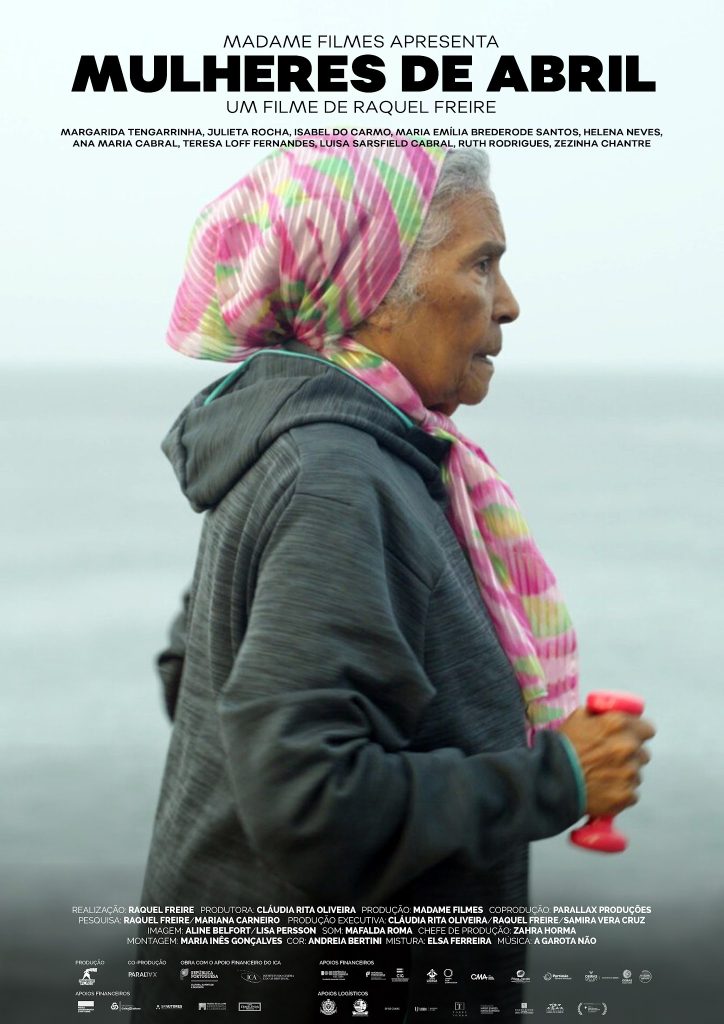
The feature film “Women of the Revolution” by director Raquel Freire celebrates the women who fought for freedom and combated colonialism during the dictatorship in Portugal.
Portugal lived for 48 years under the authoritarian regime of the so-called Estado Novo, the longest dictatorship in Europe in the 20th century. The protagonists of this film are women who actively participated in the anti-fascist and anti-colonial struggle in Africa and Portugal, and who until now had been forgotten by history, Raquel Freire told Blindspot.
Since 1961, at war with independence movements in the Portuguese colonies, the Portuguese dictatorial regime was overthrown by the revolution on April 25, 1974. The fight for freedom was a long journey, and it involved the heroic efforts of many women. Raquel Freire wanted to bring to light the firsthand testimony of these women.
Margarida Tengarrinha, Ana Maria Cabral, Helena Neves, Luísa Sarsfield Cabral, Ruth Rodrigues, Teresa Loff Fernandes, Julieta Rocha, Isabel do Carmo, Maria Emília Bederode Santos, and Josefina Chantre are the protagonists of this documentary. A film that reveals the strength of resistance of the women who, between Portugal and the occupied African territories, fought to build the April Revolution, battling in the liberation wars waged by the independence movements.
“Women of the Revolution” rescues these women from oblivion to give them a voice and restore their rightful place in history.
The documentary recently premiered at the IndieLisboa Festival, where it won the Amnesty International Award, and is shortlisted for several European and American festivals.
The roots of this project lie in family stories of anti-fascist struggle, says Raquel Freire. She grew up hearing testimonies and a moment came when she realized that the documentary had to be made while these women are still alive. I wanted to preserve the memory of five decades of resistance, especially so that it could survive and be passed on to younger generations who are unaware of it.
“The 25th of April wasn’t made in a day. Salgueiro Maia didn’t wake up one morning saying, ‘Today I’m going to call my friends and make the 25th of April,’” she emphasizes. “This fight for freedom, both in Portugal and in Africa, was yet to be told. Whenever it was told, it was only by men and about men.”
The director confesses that she faced the difficult dilemma of choosing a handful of women from among dozens of anonymous heroines who dedicated their lives to the fight for freedom. “I wanted to have as much representation as possible. We wanted maximum plurality and representation. Because we have Portuguese women, we have Cape Verdean women, we have Guinean women, we have women from different social classes, we have women from the people, and we have women who had access to education and who belonged to an elite that was already fighting in the democratic opposition against the regime. We have progressive Catholic women, we have women who were completely far from religion. We have women of various political sensibilities, we have communist women, women from the far left, socialist women, women from a more conservative area.”
Another concern that defined the film’s production was placing women at the center of the project. The protagonists were accompanied by a team of women who prioritized listening and empathy. “I don’t make films about, I make films with. So the film is made with these women and with this very generous, talented, and dedicated team,” emphasizes the director.
This concern required redoubled attention. Care was taken to ensure that the women who were imprisoned and tortured in Caxias prison did not undergo a traumatizing experience, and that they felt welcomed and dignified. In Cape Verde, the Cape Verdean producer Samira Vera Cruz conducted the questioning in Creole. “These were very delicate questions for me to ask in the language of the oppressor. So I took care to try to have a Cape Verdean woman establish this conversation, this dialogue. That, for me, was the biggest challenge.”
The documentary will be shown in schools. Raquel Freire emphasizes that cinema has a fundamental role to play in the face of populist and nationalist waves that want to rewrite history, “so that we know who we are and where we come from, so that we know our history. At this moment, young people have very little access to what our history was and to the truth, that is, to the history told by the people who made it, who built it.”
The film’s soundtrack brings together prominent figures in protest music, but the cherry on top is two singers who today embody political awareness and continuity with the history of resistance to fascism and colonialism in the Portuguese music scene: A Garota Não and the rapper Mynda Guevara. “Mynda Guevara, a rapper from Cova da Moura, is one of the protagonists of my latest film, Mulheres do Meu País (Women of My Country), and she had to be there. She is a profoundly revolutionary woman, absolutely incredible, and I would also like to have a voice that is the voice of our Zeca Afonso today, and that voice is, without a doubt, Garota Não,” concludes Raquel Freire.
Luís Guita